
Bench Warrants in Teller County
The Colorado Judicial Branch's Teller County page states the local rule plainly: if you hold a traffic or misdemeanor ticket, you must appear in person on the date printed on it, and skipping that date can bring a bench warrant for arrest. Missed hearings, contempt, broken court conditions, and ignored municipal-court orders can trigger one too. A bench warrant grows out of a duty you already owe a court. It says nothing about how the underlying charge stands. A few terms come up again and again. "Failure to appear," often shortened to FTA, means the required appearance never happened. "Recall" means the issuing court pulls its warrant back. "Quash" means the court sets it aside entirely. Teller County and Colorado sources say "bench warrant"; capias or capias pro fine is not the routine local label, so use it only when the issuing court does.
Teller County Ticket Warning
Not every Teller County ticket belongs to the same court. Some start in state County Court, others in a municipal court, and that difference decides whom to call. Cripple Creek's municipal page notes that city police write some citations into Teller County Combined Courts, so a Cripple Creek ticket does not always belong to Cripple Creek Municipal Court. Read the court name, case number, and appearance instructions on the paper first. For a state traffic or misdemeanor matter, call the Teller County Clerk of Court at 719-689-7360. Ask whether an FTA was entered, whether a bench warrant issued, and whether a judge must reset the case. Paying online is not a fix by itself. A payment can satisfy the balance while an appearance or signed recall order is still required.
How a Bench Warrant Is Issued
A Teller County bench warrant starts with an underlying case, summons, ticket, or court order already on file. The required act does not happen. The judge then reviews the record and may issue the warrant. That command authorizes an officer to arrest the named person and bring the matter back before the court. A clerk records the action, while law enforcement may receive the warrant through nonpublic justice systems.
The practical flow is: required date or condition → recorded nonappearance or noncompliance → judicial warrant → service or recall → case resumes. Teller County publishes no universal grace period, mailed-warning policy, or warrant update schedule. A person should not infer that extra time exists. The date and court order in the individual case control.
Once issued, a Teller County bench warrant stays open until the court records a lawful change, such as service, recall, or quashing. A new hearing on the public docket may help, but it does not itself prove the warrant was withdrawn.
Teller County Divisions 11 and T
Teller County Combined Courts runs separate state-court tracks. District Court Division 11 handles felony and other district matters; its published numbers are 719-689-6925 and 719-689-6926. County Court Division T handles misdemeanor, traffic, and petty-offense matters. The central Clerk of Court number is 719-689-7360.
District Court, Division 11
Felony and district-level cases. The judge controls recall and bond in the assigned case.
719-689-6925 / 6926
County Court, Division T
Misdemeanor, traffic, petty-offense, and county matters, including the published FTA warning.
719-689-7360
Case class helps with routing in Teller County. Formats include 2026CR123 for criminal, 2026M123 for misdemeanor, and 2026T123 for traffic. These are public-format examples, not actual cases.
Bench Warrant vs Arrest Warrant
Both kinds of warrant can put a person in custody, but they start differently. An arrest warrant usually rests on probable cause that an offense occurred and that the named person is tied to it. A bench warrant answers a missed court obligation in a case already open in Teller County. See the separate Teller County arrest warrant resource for the probable-cause process.
| Feature | Bench Warrant | Arrest Warrant |
|---|---|---|
| Trigger | Missed date, contempt, or noncompliance | Probable cause tied to an offense |
| Issuer | Judge acting in an existing matter | Judge or magistrate reviewing lawful support |
| Case posture | A case or court duty already exists | May begin a new custody stage |
| Resolution | Appearance, service, recall, or quashing | Arrest or surrender, bond, then court process |
A summons is different from both. It commands a Teller County resident to appear without initially authorizing arrest. Missing the summons date can bring bench-warrant action later when the law permits.
Teller County Municipal Calendars
City courts in Teller County meet on schedules unlike the state courthouse's. Woodland Park Municipal Court holds regular sessions on the second and fourth Wednesday and takes municipal traffic, ordinance, and criminal cases. Cripple Creek Municipal Court meets the second Wednesday each month at 10 a.m. Victor Municipal Court meets every other month when docketed, usually Monday at 3 p.m. Those long gaps between settings make a missed date harder to fix by guessing, so call the clerk promptly. Woodland Park is 719-687-5207, Cripple Creek is 719-689-2502, and Victor is 719-689-2284. Green Mountain Falls posts municipal-court events but lists no dedicated warrant line. Its town code also separates criminal traffic from purely noncriminal infractions, where an FTA leads to default procedures rather than an arrest warrant under the cited rule.
How to Resolve a Teller County Bench Warrant
Teller County publishes no walk-in program for clearing bench warrants. Begin with the issuing court. A judge there may recall or quash the warrant, set a new date, require an appearance, or leave it in force. No countywide recall motion form or filing fee appears in official sources.
- Find the court and case number from the ticket, summons, docket, or clerk. Ask for the exact warrant status and bond terms.
- Consult a lawyer about a motion to recall or quash and whether an arranged appearance is possible. A clerk cannot necessarily cancel a judge's order.
- Ask the court what must occur before arrival. Confirm whether payment, a new date, a motion, bond, or surrender is required.
- Complete only the court-approved step. Keep each receipt, bond paper, order, and written notice of the next court date.
- Recheck with the issuing clerk after action. Ask whether the warrant now reads recalled, quashed, or served.
Caution: Do not ignore a bench warrant or assume online payment removes it. Confirm the judge's action with the issuing clerk.
Teller County Bond and Reinstatement
Surrender and arrest both lead to the same door. If either happens, call the Teller County Detentions Facility at 719-687-7770. The money-bond rights sheet explains the rest. Bonds go through the Teller County Sheriff's Office 24 hours a day, by cash, money order, or the linked online option. Only the bond amount itself secures release on a money bond. A $10 bond fee and up to a 3.5% card fee may be charged as debt, and a $30 booking fee may be assessed. None of those extras can hold someone who is otherwise entitled to release.
The judge's order decides the bond's shape. It may be cash-only, surety, personal recognizance, or no-bond pending review. A surety works unless the court demanded cash and nothing else. Once the bond conditions are met, the official sheet promises release within six hours absent extraordinary circumstances. Electronic-monitoring arrangements can take longer. Before leaving, get the next court date from the bond paperwork.
Teller County Payment Is Not Recall
The Fourth Judicial District collections page spells out how Teller County fines get paid: in person, by phone, by mail, or online through authorized methods. The Teller counter sits at 101 W. Bennett Avenue in Cripple Creek, open weekdays from 7:30 a.m. to 5:00 p.m. To pay by phone, call 719-689-7360 and choose option 3. Checks, cash, money orders, Visa, MasterCard, Discover, and Apple Pay all work, though cash must never go through the mail. A payment plan can be requested online, by email at 04collections@judicial.state.co.us, or in person. The page lists a $25 annual processing fee for all cases. Treat these as collection routes, not a guaranteed warrant recall. Before paying anything, ask the clerk whether payment alone lifts the bench warrant or whether the judge also wants a new appearance, reinstatement, or a written order.
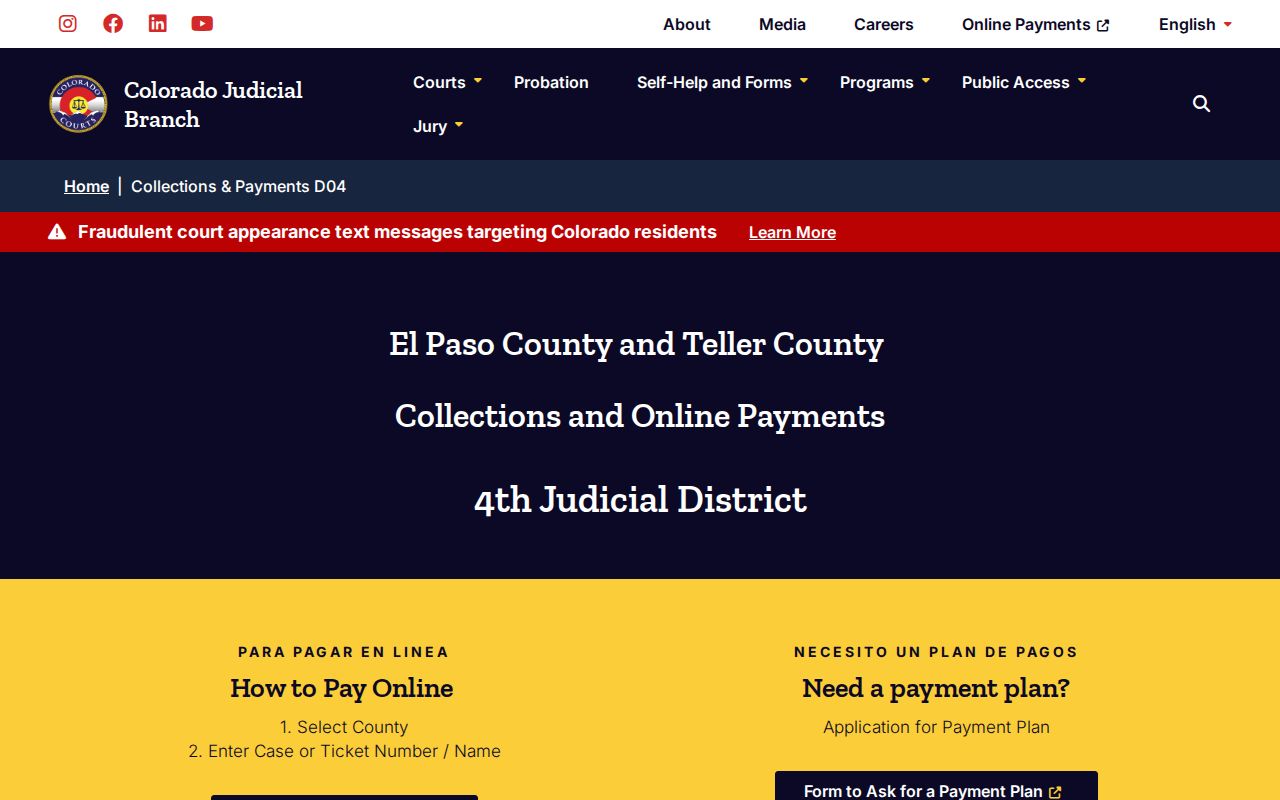
The official payment page lays out methods and plan options for Teller County. It makes no promise that a payment clears a bench warrant.
Which Teller County Court Issued It
The issuing court matters. Its judge, and nobody else, controls recall. For District or County Court, start with the Teller docket search as a lead, then call the Clerk of Court directly. City cases go through the municipal clerk named on the ticket. Deputies and police officers serve warrants, but the serving office does not replace the issuing judge's order.
Before calling, gather the exact spelling of the name, date of birth if asked for, case or ticket number, court name, the missed date, and any payment or bond receipt. Then ask four direct questions. Is the warrant active? What caused it? What must happen to recall or serve it? When is the next required appearance? When the issuing court is unclear, the Teller County warrant search path explains how to trace a state or municipal file.
- Recalled
- The court withdrew the warrant.
- Quashed
- The court set the process aside.
- Served
- An officer carried out the warrant.
- Bond forfeiture
- Court action affecting posted security after a missed duty.
Note: Keep written proof, and confirm the new status with the same Teller County clerk who controls the case.